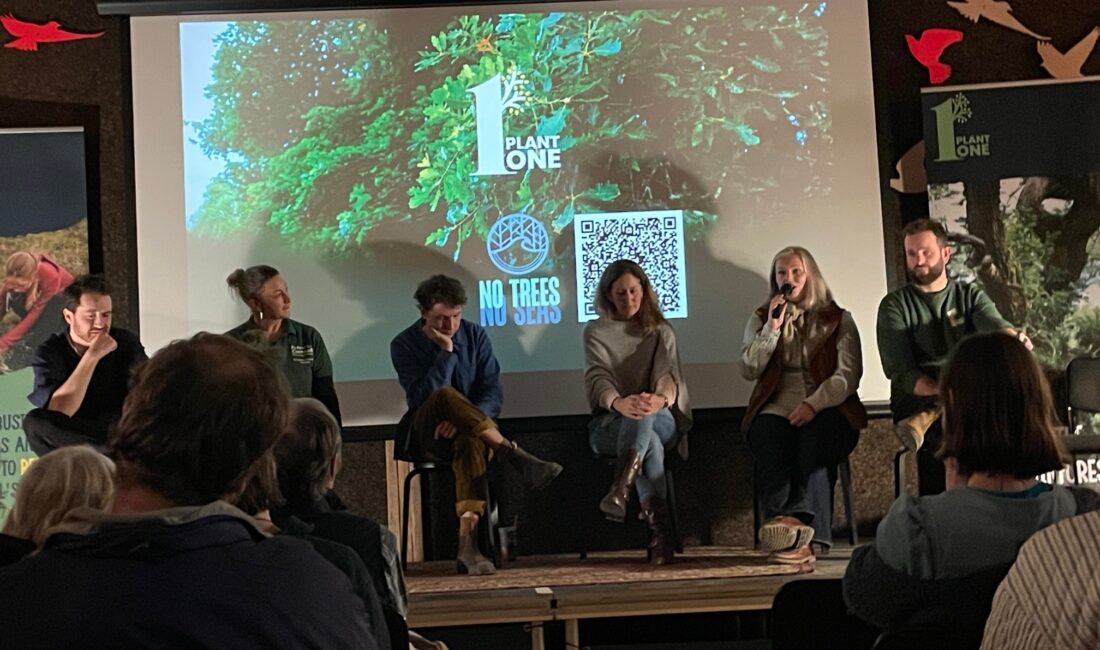
When we received the invite to this event hosted by Plant One Cornwall, the description was:
“Discover the hidden connections of our Forests and Oceans. A journey from our past to the present. How reforestation can save our oceans.
There is a continued and deep connection between our forests and oceans that has been forgotten. If we want to save our oceans, we must reforest the land. We must shape new myths and tell new stories, groundbreaking science and storytelling can work together to deliver effective nature restoration”
Interest piqued, Julian and I accepted and were treated to an inspiring and thought-provoking evening.
Carl Rowlinson from Plant One Cornwall shared they have initiated a revolutionary new campaign which highlights the symbiotic nature of our ecosystems the No Trees, No Seas Campaign.
The goal of this campaign is “to establish 500 hectares of Flowscape Forest by mapping out and targeting keys areas for woodland creation that will directly improve riparian and coastal habitats with the aim to increase fish stocks and protect seagrass and kelp beds”
This campaign was inspired by a groundbreaking scientific review, Environmental connections between forests and oceans by Dr Benjamin Phillips published in July 2025 by Exeter University and commissioned by the Woodland Trust.
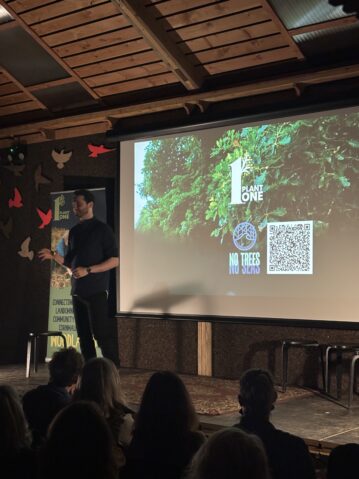
Completely capturing our attention, we were treated to thought provoking stories and tasks by Sam Crosby, Mythologist, Facilitator & Guide. I am unable to do Sam’s talk justice here, all I can say is that you are a lucky person if you ever get the chance to participate in one of his talks. Sam’s opening statement was “people have lost meaning”. He shared with us a dark period in his life and explained that it was a strange old story that helped him to rationalise what he was going through. This story translates for all of us in some form and certainly for me, sitting there listening to what he had to say and participating in his tasks really did open my mind and encourage me to look beyond the obvious!
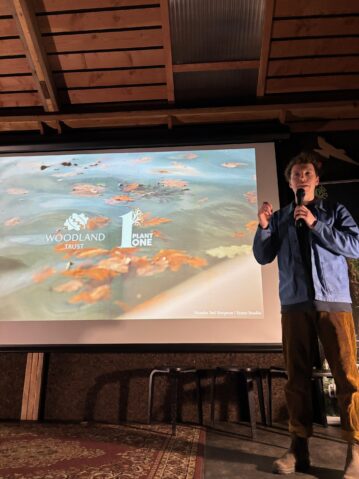
These stories have meaning and often in them is the knowledge we used to have. Sam Manning, Forest Ecologist for the Woodland Trust went on to tell us about an old Japanese proverb “If you want to catch a fish, plant a tree”.
They have this idea of the forest and the ocean as intertwined lovers and that there was once a conversation between those two which was essential to that relationship.
Our vocabulary does not encapsulate this concept, so the word ‘Flowscape’ has been coined to describe this single living eco system. It is looking at the cycles, the processes and the flows of energy between those ecosystems.
Sam explained how the forests slow water flow, reducing flooding and filtering pollution which in turn protects kelp and sea grass. Seagrass and kelp are essential habitats, supporting biodiversity and absorbing carbon but they struggle to thrive when coastal waters become turbid or overloaded with nutrients.
Decomposition of the forest floor creates Fulvic acid which help plankton unlock iron, phosphorus and nitrogen forming a natural ‘Forest Tea’ which supports the base of the marine food web.
The sea also gives back to the forest by supporting life on land. Birds for example sea eagles and animals such as otters eat the fish and the nutrient rich remains they leave feed the soil, accelerate tree growth and support a web of life including mosses, insects, birds and other animals.
Humans are currently not aligning themselves with the complexity of that system, but we have the potential to be a Hyper Keystone species. This means we have the ability to make that system more complex and more robust, stable and diverse.
In the past, individual charities, conservation groups, government departments etc have tended to work as separate entities and on an individual problem i.e. the RSPB would deal with birds, the Forestry Commission worked with trees etc and Carl and Sam were keen to share with us that more frequently now these organisations are coming together and working in an holistic approach. Working with Plant One Cornwall and generously there to answer our questions alongside Sam Manning and Sam Crosby were Dr Lissa Batey, Marine Ecologist, Jenny Rogers, Forest for Cornwall and Pollyanna Harris, Forestry Commission.
A big thank you to you all!